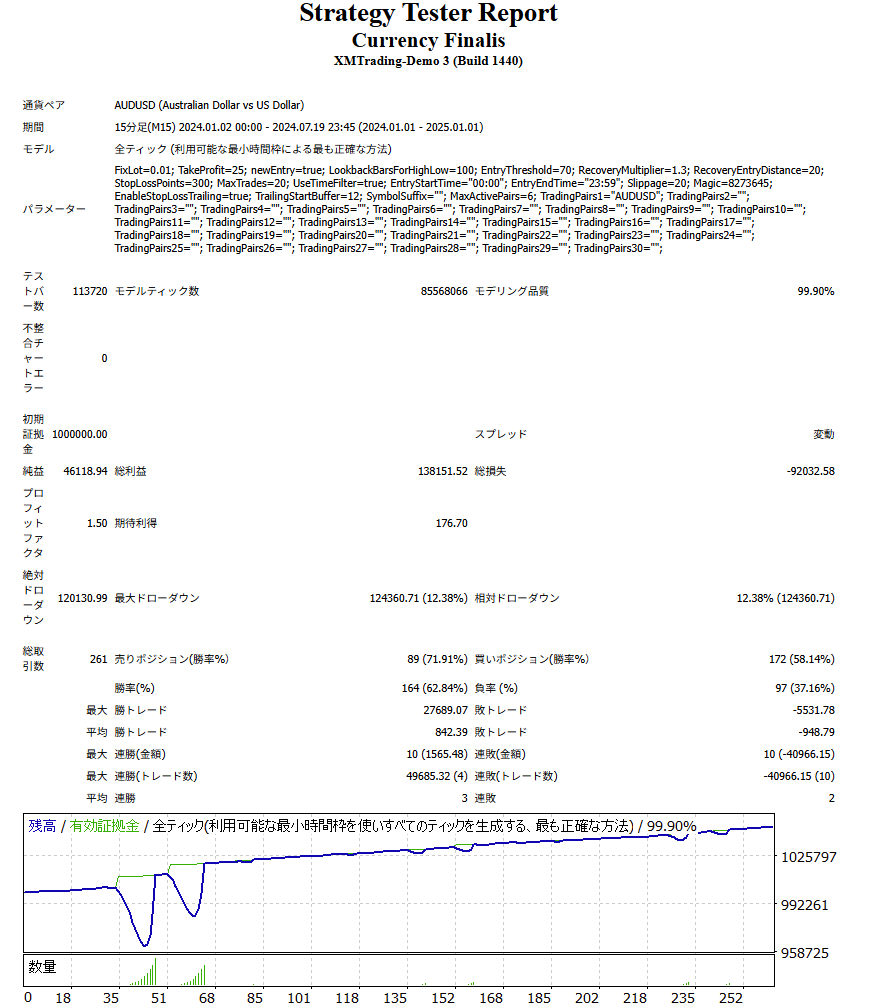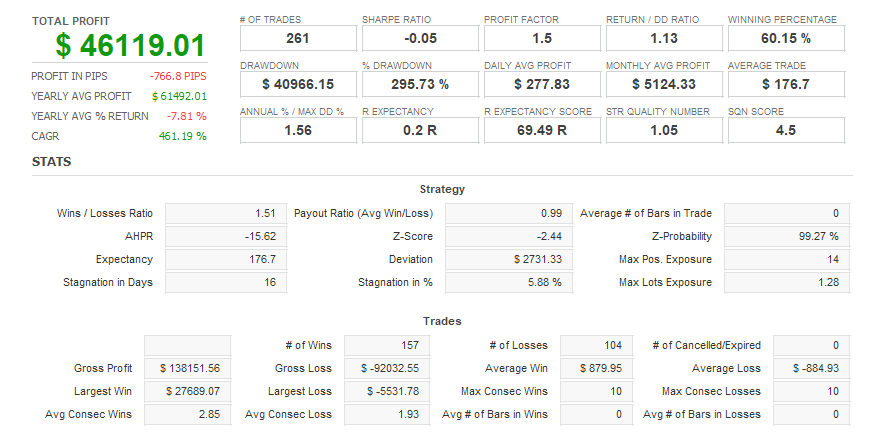



Currency Finalis supports up to 30 currency pairs, monitoring multiple pairs at the same time.
Key Features

Averaging-down (recovery logic) built in
Adds positions with automatically increasing lot sizes as price moves away from the entry. Up to 20 levels are supported, letting you build a portfolio with strong recovery power.
Trailing stop
Once a position is carrying a certain amount of profit, the stop-loss line is moved up automatically, locking in gains while keeping risk to a minimum.
Time-of-day filter
Entries can be limited to any time window you choose, so you can stay out of the late-night session or steer clear of economic announcements.
Auto-close
Based on the number of open positions and the price-deviation conditions, positions are closed automatically once the take-profit condition is met.
Entry Logic
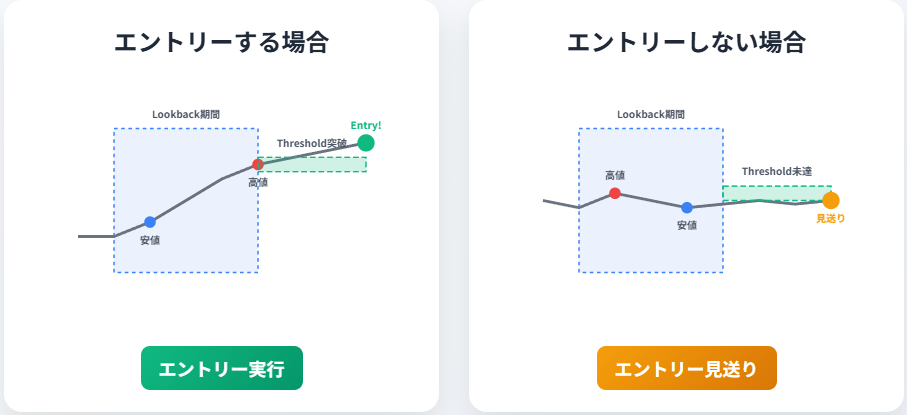
The entry logic uses the relationship between the highs and lows over a specified period (Lookback × Threshold) as its indicator, aiming to build positions at the start of a trend or at a reversal.
In other words, it analyses past price movement to decide when to enter.
First it identifies the highest high and lowest low within the set period, then applies a threshold to them.
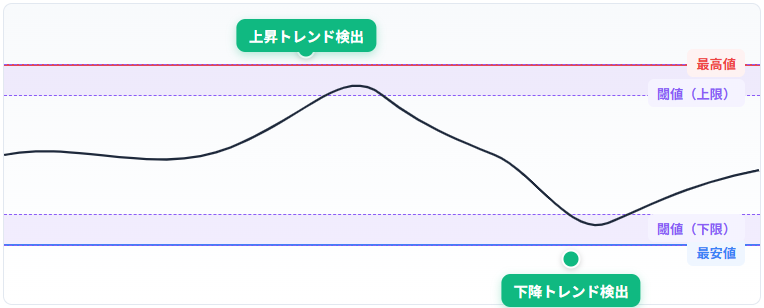
This is how it picks out the points where a trend is starting to form or where the direction is turning.
And when no clear buy or sell signal can be confirmed, it stays out of the market, keeping risk down and trading efficiently.
Settings (example)
-
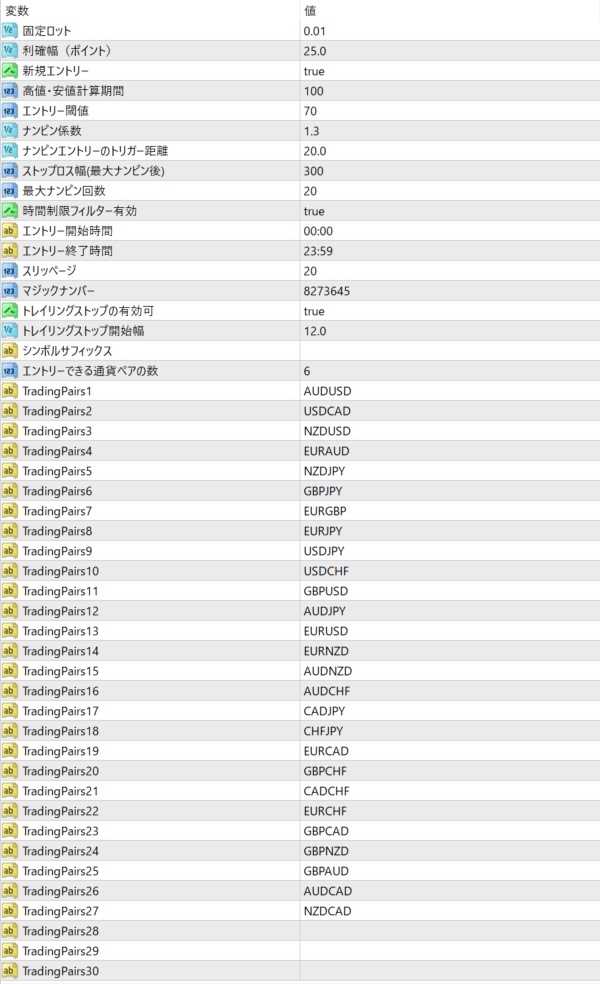
Lot: fixed 0.01 (UseAutoLot=false)
-
Take profit: 25 points
-
Stop loss: 300 points
-
Averaging-down step: 20.0 points
-
Maximum averaging-down levels: 20
-
Entry hours: 00:00–23:59 (no restriction)
-
Trailing stop / auto-close: enabled
-
Chart setup: one-chart setup
① Stability-focused portfolio (mainly majors)
USDJPY / EURUSD / AUDUSD / EURGBP / USDCAD / AUDCAD
-
Recommended margin: JPY 500,000
-
Recommended timeframe: M15
-
MaxActivePairs (number of symbols allowed at the same time): 3
Relatively low volatility, so the risk while averaging down is mild.
Easy to handle even if this is your first averaging-down EA, and ideal for stable long-term operation.
② Balanced portfolio (includes medium-volatility pairs)
EURJPY / GBPUSD / NZDJPY / EURAUD / GBPAUD / AUDCHF
-
Recommended margin: JPY 700,000
-
Recommended timeframe: M15
-
MaxActivePairs: 3–4
Built mainly around pairs with a medium trading range.
Lets you run the EA with an eye on the balance between profitability and stability.
③ High-yield portfolio (mainly high-volatility pairs)
GBPJPY / GBPNZD / EURNZD / CHFJPY / CADJPY / GBPCAD
-
Recommended margin: JPY 1,000,000
-
Recommended timeframe: M15
-
MaxActivePairs: 2
Spare margin to absorb sudden moves is a must.
A configuration that targets short-term profits but also carries higher risk.
Recommended for intermediate traders and above.
④ Diversified minor-pair portfolio (medium to high spread)
NZDCAD / NZDCHF / CADCHF / EURNZD / AUDNZD / GBPAUD
-
Recommended margin: JPY 800,000
-
Recommended timeframe: M15
-
MaxActivePairs: 2–3
Spreads are wider, but the pairs are chosen for their tendency to move within a range.
Avoids correlated currencies — a design built for diversification.
⑤ Simple setup (single or dual pair)
USDJPY / EURUSD
-
Recommended margin: JPY 300,000 and up
-
Recommended timeframe: M15–M30
-
MaxActivePairs: 1–2
Runs with a minimal configuration.
For anyone who wants to simply confirm how it behaves, and ideal for starting small.
Also suits adding pairs gradually as you get to know how the EA works.
About the default currency-pair configuration
Currency Finalis lets you register up to 30 currency pairs as entry targets, and the 26 pairs below are pre-registered by default. Managing multiple currencies from a single chart gives you simple, flexible portfolio operation.
Default registered currency pairs (TradingPairs1–26)
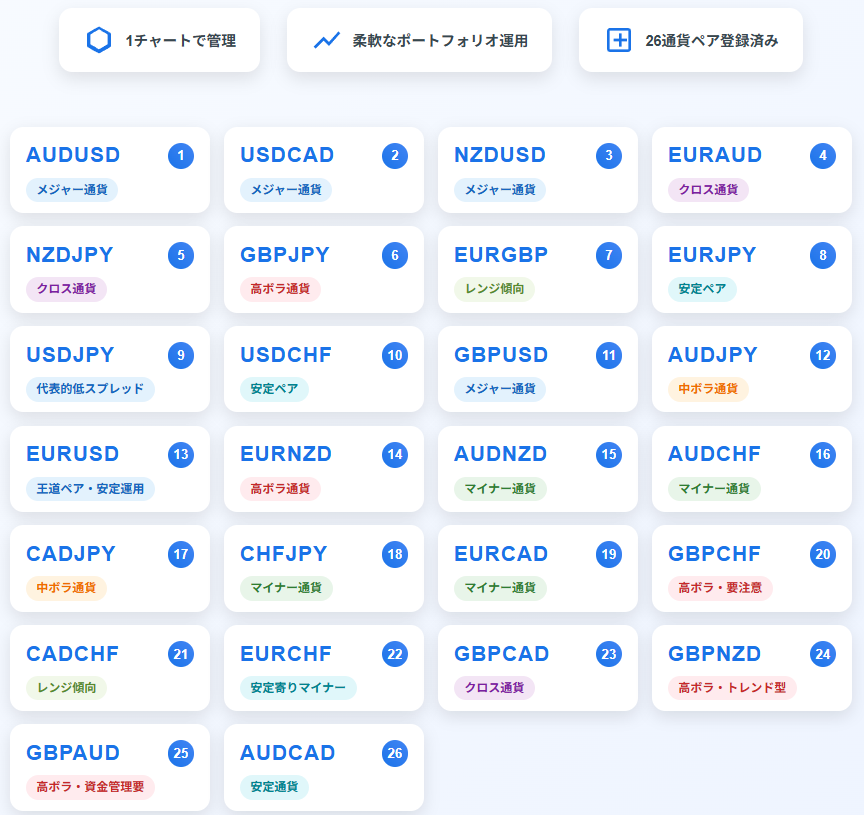
| No. | Currency pair | Notes |
|---|---|---|
| 1 | AUDUSD | Major pair |
| 2 | USDCAD | Major pair |
| 3 | NZDUSD | Major pair |
| 4 | EURAUD | Cross pair |
| 5 | NZDJPY | Cross pair |
| 6 | GBPJPY | High volatility |
| 7 | EURGBP | Tends to range |
| 8 | EURJPY | Stable pair |
| 9 | USDJPY | Typical low-spread pair |
| 10 | USDCHF | Stable pair |
| 11 | GBPUSD | Major pair |
| 12 | AUDJPY | Medium volatility |
| 13 | EURUSD | Classic pair, suited to stable operation |
| 14 | EURNZD | High volatility |
| 15 | AUDNZD | Minor pair |
| 16 | AUDCHF | Minor pair |
| 17 | CADJPY | Medium volatility |
| 18 | CHFJPY | Minor pair |
| 19 | EURCAD | Minor pair |
| 20 | GBPCHF | High volatility, watch the spread |
| 21 | CADCHF | Tends to range |
| 22 | EURCHF | Minor pair on the stable side |
| 23 | GBPCAD | Cross pair |
| 24 | GBPNZD | High volatility, trending |
| 25 | GBPAUD | High volatility, money management required |
| 26 | AUDCAD | Stable pair |
Operating notes
-
These pairs form a candidate list of up to 26 currency pairs; in live operation the number running at once is controlled by
MaxActivePairs(for example, 3–6 pairs is recommended). -
To disable a pair, simply leave the corresponding
TradingPairsXfield blank. -
The recommended timeframe is M15.
It can also run on M5, but be aware that it becomes more sensitive to spreads and server latency.
CurrencyFinalis_Parameter_List